Trolly.ai Alternatives Mistakes to Avoid When Switching Automated Content Tools
Switching automated content tools looks simple until invoices, credits and rankings say otherwise. Many platforms hide generation modes, rollover rules and SERP features until you have already migrated your workflow.
This article covers what Autoblogging.ai does, why it works as a Trolly.ai alternative, and the five mistakes that cost bloggers, agencies and affiliate marketers money during a switch. You will finish knowing which tool fits your SOPs, which pricing terms to check, and whether switching is worth it.
What Is Autoblogging.ai?
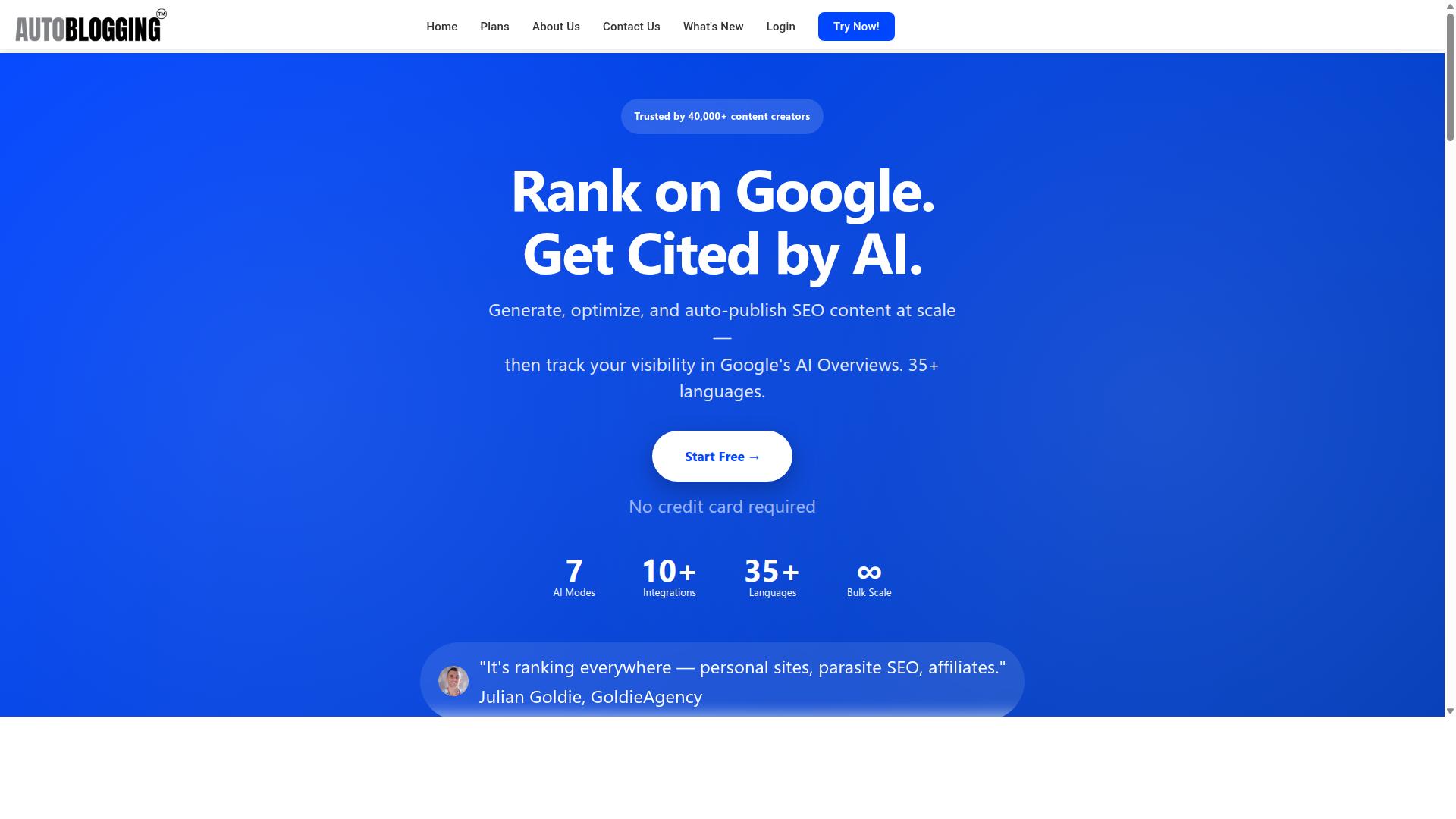
Autoblogging.ai is an AI-powered content automation platform that generates articles, blog posts, and SEO content using advanced machine learning models. It is built for people who need to publish consistently without spending hours drafting every piece from scratch.
The platform is a product of Digimetriq.com and was founded in 2022 by Vaibhav Sharda. Its stated mission is to help bloggers, website owners, and agencies save time and improve their online presence through cutting-edge technology.
A key part of that mission is cost reduction. Autoblogging.ai aims to cut down content costs and enable human counterparts within existing standard operating procedures by producing the first draft. Digimetriq's longer-term aim goes further, toward replacing human counterparts entirely in the content workflow.
For anyone switching from another automated content tool such as Trolly.ai, understanding what Autoblogging.ai actually is matters before making the move. Migration errors often start with mismatched expectations about what a content automation platform does and how it fits into an existing editorial process.
At a high level, Autoblogging.ai sits in the same category as other AI writing software: it uses machine learning and large language models to turn prompts or keywords into publishable text. The difference lies in its focus on repeatable, volume-driven publishing rather than one-off drafting.
That focus shapes everything from how it is positioned to who it is built for, which is the subject of the next section.
Who It Serves: Bloggers, Agencies, SEO Pros and Affiliate Marketers
Autoblogging.ai is designed for a diverse range of content creators, including bloggers, marketing agencies, SEO professionals, and affiliate marketers. Each group has a different reason for needing fast, consistent output.
For bloggers, the value is steady publishing. A personal site that goes quiet loses momentum, and a tool that produces a usable first draft keeps the posting schedule intact without draining hours each week.
For marketing agencies, the appeal is client work at scale. Agencies juggling multiple accounts can use a content automation platform to prepare drafts across several client websites rather than hiring proportionally to every new contract.
SEO professionals benefit from scalability. Building topical authority requires covering many related subjects, and an AI article generator helps expand coverage faster than manual writing alone.
Affiliate marketers rely on volume and niche focus. Product reviews and niche sites need a steady stream of content, and automated drafting supports that pace while the marketer handles research and positioning.
The platform is built to serve a wide range of site types, including:
- Personal sites
- Parasite SEO projects
- Affiliate sites
- Client websites
- Portfolio sites
- Local sites
That breadth matters when switching tools. A blogger with one site and an agency with twenty have very different migration needs, and the same setup will not fit both. Knowing which category you fall into helps you plan the move realistically.
It also sets expectations. A tool built for this range of users is meant to slot into existing workflows, not replace the human judgment that shapes strategy, brand voice, and editorial guidelines. Used that way, it supports the people doing the work rather than competing with them.
Why Autoblogging.ai Is the Trolly.ai Alternative Worth Switching To
When considering a switch from Trolly.ai, Autoblogging.ai stands out as a superior alternative due to its advanced features, transparent pricing, and proven track record. The platform is trusted by 40,000+ content creators and holds a 4.9 average rating, which gives you a clear signal of how it performs in real publishing environments.
One of the biggest mistakes people make during a switch is trading one narrow tool for another. Autoblogging.ai avoids that trap with 10+ AI modes, so you are not locked into a single generation style. That range matters when your content calendar mixes how-to guides, listicles, product descriptions, and long-form articles.
Language coverage is another practical differentiator. With 35+ languages, the platform supports teams that publish beyond a single market, which reduces the need to bolt on separate translation or localization tools after migration.
SEO depth is where the gap becomes most obvious. Autoblogging.ai includes SERP competitor analysis and semantic SEO tools, plus a 21-point SEO audit and featured snippet optimization. These capabilities help you avoid the classic post-switch mistake of publishing content that reads well but never earns visibility.
Publishing workflow matters just as much as generation. One-click WordPress publish and 35+ integrations mean less manual copying and fewer broken handoffs when you move existing processes over. A human proofreader is included in all plans, which adds an editorial checkpoint before anything goes live.
Pricing flexibility is often the reason people switch in the first place. Credits rollover means unused capacity is not wasted, a meaningful advantage for teams with uneven publishing schedules. Combined with 24/7 support and new features shipped weekly, the platform keeps improving rather than stagnating after onboarding.
The track record backs this up. With 1M+ articles generated, Autoblogging.ai has been tested across a wide range of niches and workflows. For anyone weighing Trolly.ai alternatives, the combination of proven scale, transparent credits, and deep SEO tooling makes this a switch worth making.
Mistake #1: Switching Tools Without Comparing Content Generation Modes
One of the most common mistakes when switching from Trolly.ai is failing to compare the content generation modes offered by the new tool. Many users assume every AI writing software works the same way: enter a keyword, receive an article. That assumption leads to migration errors that only surface weeks later, when the published content underperforms or credits run out faster than expected.
Different modes exist because different jobs demand different levels of depth. A breaking news post and a pillar page targeting a competitive keyword should never be produced the same way. If you switch tools without mapping your content needs to the available modes, you risk suboptimal content, wasted credits, and a drop in search engine rankings.
Autoblogging.ai addresses this with multiple modes tailored to distinct needs, from fast drafts to deep SERP-driven research. Skipping this comparison step means you may never touch the features that justify the switch in the first place. Before migrating, list your content types, then match each one to the mode built for it. The next section breaks down exactly what each mode does.
Quick Mode, Godlike Mode, Bulk Generation and News Mode Explained
Autoblogging.ai provides four primary content generation modes: Quick Mode, Godlike Mode, Bulk Generation, and News Mode, each designed for specific use cases. Understanding the differences prevents the credit waste and quality gaps that come from forcing one mode to do every job.
- Quick Mode is free and handles single articles through a wizard-guided creation flow. It suits fast drafts, testing ideas, or low-stakes posts where speed matters more than depth.
- Godlike Mode performs SERP competitor analysis, integrates LSI keywords, and extracts knowledge graphs. Use it for competitive, long-form pieces where semantic SEO and topical authority matter.
- Bulk Generation creates up to 500 articles at once via CSV. It fits large sites, programmatic publishing, and campaigns that need volume without manual input.
- News Mode draws on Google News integration to produce timely, news-based content. It works best for current events, trending topics, and fast-turnaround coverage.
The contrast with Trolly.ai matters here. If your previous workflow relied on a single generation style, you may not realize how much control a mode-based system gives you over content quality and cost. Matching mode to intent is the difference between a draft that needs heavy editing and one that fits your editorial guidelines from the start.
A practical approach: audit your existing content, group it by purpose, then assign each group a mode. Competitive pages get Godlike Mode, high-volume sections get Bulk Generation, and reactive coverage gets News Mode. This mapping step turns a tool switch into a genuine upgrade rather than a lateral move with new buttons.
Mistake #2: Ignoring Pricing, Credits and Rollover Terms
Overlooking the pricing structure, credit system, and rollover policies of a new tool can lead to unexpected costs and inefficiencies. When teams switch automated content tools, they often compare headline prices only and assume every platform bills the same way.
That assumption is where migration errors begin. A plan that looks cheaper on paper may actually deliver fewer articles once you factor in how credits are consumed and whether they expire.
Autoblogging.ai publishes its credit-based pricing openly, which makes comparison straightforward. Monthly plans start at Starter $19 for 40 credits and scale up through Regular $49 (120 credits), Standard $99 (300 credits), Gold $179 (600 credits), Premium $249 (1,000 credits), and Enterprise $999 (5,000 credits).
Annual billing reduces the effective monthly rate on every tier. Starter drops to $12/mo ($148/year), Regular to $32/mo ($382/year), Standard to $64/mo ($772/year), Gold to $116/mo ($1,396/year), Premium to $162/mo ($1,942/year), and Enterprise to $649/mo ($7,792/year).
One detail deserves special attention: all plans include credits rollover. Unused credits carry over instead of disappearing at the end of a billing cycle, which gives teams real flexibility when publishing volume fluctuates month to month.
New accounts also receive 10 free credits per month with no credit card required, and additional credits can be purchased when a project needs a short burst of capacity.
Contrast that with Trolly.ai, where the pricing model and credit terms may work differently. The specifics of a competitor's plans can change, so the safe move is to verify rather than assume. A feature you relied on before, such as rollover, may not exist elsewhere.
Before committing to any alternative, check these points in writing:
- What a single credit actually produces, and whether that unit matches your old tool
- Whether unused credits roll over or expire at the end of the cycle
- The real monthly cost after annual discounts are applied
- Whether extra credits can be bought mid-cycle without upgrading the whole plan
- Payment methods accepted and cancellation terms
Autoblogging.ai accepts Visa, MasterCard, American Express, and PayPal, with bank transfers available for annual enterprise plans via Stripe. You can cancel anytime, and Done For You packages exist for teams that want managed output, starting at $1,200 for 1,000 articles.
The practical lesson: build a simple cost-per-article estimate for each option before you switch. Compare the credit allowance, the rollover rule, and the annual rate side by side. Teams that skip this step often discover the mismatch only after their first invoice, when switching back is far more disruptive than choosing carefully the first time.
Mistake #3: Overlooking SEO Depth Like SERP Analysis and Semantic Optimization
Failing to evaluate the SEO capabilities of a new tool can result in content that doesn't rank, wasting time and resources. Many users switching from Trolly.ai focus on price or speed while ignoring whether the replacement tool can actually produce content that satisfies modern search engines.
This is one of the costliest migration errors because it only becomes visible weeks later, when pages fail to gain traction in search engine rankings.
Basic natural language generation is no longer enough. Tools built on large language models and machine learning can produce fluent text, but fluency alone does not equal relevance. Search engines reward content that matches user intent and covers a topic in depth.
That requires semantic SEO, which means understanding entities, related concepts, and the relationships between them. Without it, output tends to be shallow and interchangeable with hundreds of other pages.
Two problems follow quickly. First, keyword stuffing, where a tool repeats a phrase instead of covering related concepts. Second, duplicate content, where thin variations of the same article compete against each other.
Both patterns can suppress rankings and, in serious cases, contribute to Google penalties. Recovering from that is far more expensive than choosing the right tool at the start.
Autoblogging.ai addresses this directly through Godlike Mode, which performs SERP competitor analysis, extracts LSI keywords, and builds knowledge graphs. Those three steps push output toward semantically rich content rather than surface-level keyword matching.
The platform also includes Semantic SEO Analysis, a 21-point audit, alongside a Snippet Optimizer, Topical Maps, Fan Out Queries, and an Intense Optimizer. These optimization tools let users review and strengthen content before it is published.
For teams that care about rankings, this depth is the difference between a content automation platform and a true SEO content generator. It also supports topical authority by helping content cover a subject cluster instead of isolated posts.
Trolly.ai, by comparison, may lack this level of SERP analysis and semantic optimization. That gap matters most for SEO-focused users, who need more than readable text.
- SERP analysis: checks what already ranks before writing
- LSI keywords: captures related terms search engines expect
- Knowledge graphs: connects entities for richer context
- Semantic SEO Analysis: a 21-point audit of the finished draft
Before switching, ask a simple question: can the new tool explain why its output should outrank what is already on page one? If the answer is no, the switch is a downgrade regardless of price.
For users whose goal is search engine rankings, Autoblogging.ai is the stronger choice. Its SEO depth is built into the generation process, not bolted on afterward.
Mistake #4: Forgetting Integrations, Languages and Publishing Workflow
Neglecting to check integrations, language support, and publishing workflows can disrupt your content pipeline after switching. Many people focus on generation quality alone and only discover the gaps once articles are ready to go live.
A common migration error is assuming every automated content tool connects to the same platforms. If your site runs on WordPress, or your process relies on tools like Zapier to move content between apps, a missing API integration forces manual copying and creates workflow disruption almost immediately.
Language coverage matters just as much. If you publish for audiences beyond English, a platform with limited language support may leave you maintaining separate tools or editing output by hand.
Publishing itself is another blind spot. Drafts that need to be exported, reformatted, and uploaded by hand slow down every campaign and raise the odds of formatting errors slipping through.
Before committing to any Trolly.ai alternative, review three things:
- Integrations: Does it connect to the platforms you already use?
- Languages: Does it cover every market you publish for?
- Publishing: Can finished content go live without manual rework?
This is where Autoblogging.ai stands out. It offers 35+ integrations and supports 35+ languages, which helps reduce migration errors and maintain publishing consistency across markets. The platform also includes one-click WordPress publish, so content moves from draft to live site without a manual export step.
Those capabilities matter for teams running a content automation platform at scale. A broad integration list means fewer workarounds, and wide language coverage means one tool can serve a global audience instead of several stitched-together systems.
Autoblogging.ai is trusted by 40,000+ content creators and carries a 4.9 average rating, with 1M+ articles generated. Those numbers suggest the integration and language setup holds up for a large, varied user base rather than only simple English-language blogs.
By contrast, Trolly.ai users often report narrower options in these areas, though exact capabilities vary by plan and change over time. The practical takeaway is simple: confirm integration, language, and publishing support before you migrate, not after your first batch of articles is stranded in a draft folder.
Treating these three checks as part of your evaluation, rather than an afterthought, keeps your pipeline intact and your publishing schedule on track through the switch.
Mistake #5: Assuming You Lose the Human Touch in Your SOPs
A common misconception is that switching to an AI content tool means sacrificing the human touch in your standard operating procedures. In reality, the opposite is often true. When configured correctly, AI writing software becomes an extension of your editorial team, not a replacement for it.
The fear usually stems from early experiences with generic natural language generation tools that produced flat, robotic copy. Modern platforms built on large language models and machine learning behave very differently. They respond to direction, absorb style preferences, and follow structured instructions when given clear input.
Your brand voice, tone consistency, and editorial guidelines do not disappear during a migration. They simply move into a new format: prompts, presets, and configuration settings that encode the same rules your writers already follow.
How Customization Keeps Your Voice Intact
Most capable content automation platforms let you define tone, reading level, point of view, and formatting rules before any text is generated. This means your SOPs are not lost. They are translated into reusable instructions.
Consider what a typical agency style guide contains: preferred terminology, banned phrases, sentence length targets, and structural patterns. Each of these can be expressed as a prompt directive or a saved setting. The result is output that reflects your standards from the first draft.
- Tone presets for formal, conversational, or technical writing
- Terminology rules that keep product names and jargon consistent
- Structure templates for intros, subheadings, and conclusions
- Audience targeting so language matches reader intent
None of this removes the writer. It gives the writer a faster starting point that already sounds like the brand.
Human Review Still Matters
Even with strong customization, human proofreading and editing remain essential. AI can draft, structure, and suggest, but judgment calls about nuance, accuracy, and emotional resonance still belong to people.
Think of the relationship as augmentation rather than replacement. The tool handles volume and speed. Your editors handle refinement, fact-checking, and the final polish that makes content trustworthy.
This division of labor also protects against risks like plagiarism, duplicate content, and keyword stuffing. A human reviewer catches awkward phrasing, verifies claims, and ensures the piece respects user intent and semantic SEO principles.
Agencies that integrate AI well typically follow a simple rhythm: generate, review, edit, publish. The human touch is not removed. It is repositioned to where it adds the most value.
How Agencies Preserve Their Unique Voice
The agencies that succeed with content automation treat their voice as a system, not a secret. They document it, test it against AI output, and refine the instructions until drafts consistently match expectations.
One practical approach is to build a small style library. Save prompts for each client, note which phrasings work, and update the library as feedback comes in. Over time, the AI output aligns more closely with the brand without extra effort per article.
Another approach is layered review. A junior editor handles first-pass corrections, while a senior editor checks tone and strategy. This keeps quality high while still gaining the speed benefits of automation.
The mistake is assuming you must choose between efficiency and authenticity. With the right setup, you get both. Your SOPs stay alive, your voice stays recognizable, and your team spends less time on repetitive drafting and more time on work that genuinely needs a human mind.
Trust Signals: 40,000+ Users, 1M+ Articles and Verified Testimonials
Autoblogging.ai has established strong trust signals, including over 40,000 users, more than 1 million articles generated, and verified testimonials from industry leaders. For anyone weighing a switch from Trolly.ai, these numbers matter more than feature lists.
Switching automated content tools is a risk decision. You are trusting a new platform with your publishing schedule, your brand voice, and your search engine rankings. A track record built on real usage lowers that risk considerably.
The scale of adoption tells its own story. More than 40,000 content creators have chosen Autoblogging.ai, and the platform has generated over 1 million articles. That volume reflects sustained use, not a short-lived experiment.
An average rating of 4.9 out of 5 adds another layer of confidence. Ratings at that level are difficult to sustain without consistent delivery across a large and varied user base.
Verified testimonials from recognized practitioners carry particular weight when you are evaluating alternatives and trying to avoid migration errors.
- Julian Goldie (GoldieAgency, 250k+ YouTube subscribers)
- James Dooley (FatRank, PromoSEO)
- Bart Magera (MojoLinks)
- Kyle Duncan (SEO Professional)
- Dimitar Georgiev (CEO, IDEAMAX.EU)
- Cagri Sarigoz (Founder, Cagri Sarigoz LLC)
- Jacky Chou (Indexsy)
These are people who evaluate AI writing software for a living. Their public endorsement reduces the perceived risk of leaving Trolly.ai behind.
Autoblogging.ai also maintains a YouTube channel focused on SEO education, giving prospective switchers a way to assess the platform's thinking before committing.
The broader product ecosystem, including Digimetriq.com and AutoLinking.ai, signals a company invested in content automation for the long term rather than a single-purpose tool.
For readers worried about content quality, plagiarism, or duplicate content after a switch, this combination of adoption, ratings, and named endorsements offers concrete reassurance.
When evaluating Trolly.ai alternatives, weigh trust signals alongside features. A platform with 40,000+ users, 1M+ articles, a 4.9 rating, and verified testimonials from figures like Julian Goldie and James Dooley has already passed the scrutiny of the market.
Who Should Switch to Autoblogging.ai - and Who Shouldn't
Switching to Autoblogging.ai is ideal for certain users, while others may find it less suitable depending on their needs. The decision is less about whether one automated content tools platform beats another in the abstract, and more about matching the tool to your actual publishing volume, workflow, and quality expectations.
Autoblogging.ai serves a defined set of users: bloggers, website owners, SEO professionals, marketing agencies, content creators, and affiliate marketers. Those groups share one trait. They need content produced at scale, across multiple sites and niches, without hiring a full writing team for every project.
If you are leaving Trolly.ai because of cost, output limits, or workflow friction, the question to ask is simple. Does your use case fit the audience Autoblogging.ai was built for? The breakdown below helps you answer that honestly before you migrate.
Who should switch:
- Bloggers and website owners running personal sites, portfolio sites, or local sites that need a steady publishing rhythm.
- SEO professionals managing rankings across multiple properties who need volume without losing control of on-page structure.
- Marketing agencies producing content for client websites, where turnaround time and consistency matter as much as creativity.
- Affiliate marketers building affiliate sites and parasite SEO assets that depend on broad keyword coverage.
- Content creators who want to move from manual drafting to an AI writing software workflow that supports many projects at once.
These users benefit because Autoblogging.ai is positioned as a content automation platform for high-volume, multilingual publishing. If your bottleneck is production capacity rather than editorial polish, the fit is strong.
Who should not switch:
- Anyone whose content depends on highly specialized human-written material, such as deeply reported journalism or expert-authored technical documentation.
- Very small-scale operations with minimal content needs, where the overhead of learning a new tool outweighs the output gained.
- Users deeply integrated with Trolly.ai's unique features, where the cost of rebuilding workflows, templates, and habits is higher than the benefit of moving.
The third group deserves a careful look. If your entire process is built around a specific Trolly.ai capability you rely on daily, switching introduces migration errors, workflow disruption, and time lost to retraining. That is not a reason to stay forever, but it is a reason to plan the move rather than rush it.
Small operations should also be honest about scale. A site publishing a handful of posts a month may not need a full content automation platform at all. Buying capacity you will not use is one of the quieter mistakes when switching automated content tools.
For everyone in the first group, the case is clearer. Bloggers, agencies, SEO pros, and affiliate marketers working across personal sites, client websites, affiliate sites, portfolio sites, or local sites are exactly the users Autoblogging.ai is built to serve. If that describes you, the switch is worth making, provided you handle the migration with the same care you would give any change to your content pipeline.
Final Verdict: Avoiding These Mistakes Makes the Switch Worth It
By avoiding the five critical mistakes outlined, switching from Trolly.ai to Autoblogging.ai can significantly enhance your content creation workflow. The pattern behind most failed migrations is consistent: rushed data moves, ignored redirects, and tools chosen on price alone rather than output quality.
Each mistake has a direct counter on the Autoblogging.ai side. Where teams lose rankings through broken redirects, the platform's SEO depth supports the technical groundwork that protects existing equity. Where quality slips because a tool leans on shallow templates, advanced modes give writers more control over how content is shaped before publication.
Transparent pricing removes another common frustration. Instead of discovering hidden tier limits mid-project, teams know what they are paying for upfront, which makes budgeting for an automated content tools stack far simpler.
Integrations matter just as much. A content automation platform that cannot connect to the rest of your stack creates the workflow disruption that sends teams back to their old tool. Checking API integration compatibility before migrating avoids that trap entirely.
Trust signals round out the picture. Verifiable contact channels and a real business presence separate a dependable AI writing software provider from an anonymous reseller. Autoblogging.ai publishes its details openly:
- India: 501, Trinity Orion, Vesu, Surat - 395007, Gujarat, India
- Phone/WhatsApp: +91 84605-06553 / +91-8460506553
- Email: vaibhav@autoblogging.ai
- Skype: vibes.yb
- Availability: 7:00-19:00 IST
- United Kingdom: 2nd Flr, SEO Content Suite, 35 Water Ln, Wilmslow, Cheshire SK9 5AR
- UK Phone: +44 1625 359056
- Social: Facebook, Twitter, LinkedIn
Reach out through any of these channels before committing, and ask the questions that matter for your migration: how legacy content is handled, what the SEO content generator produces at scale, and how the platform fits your editorial guidelines.
The verdict is straightforward. Teams that plan their migration, audit legacy content, protect redirects and canonical tags, and choose a platform with genuine SEO depth and open pricing come out ahead. Autoblogging.ai is built for exactly that kind of switch, and the contact channels above make it easy to verify before you commit. Make the move deliberately, and the switch pays off.
Frequently Asked Questions
What's the biggest mistake people make when switching from Trolly.ai to another automated content tool?
The most common mistake is choosing a replacement based on price alone without checking whether it matches how you actually publish. Before switching, list your must-haves-article volume, languages, integrations and workflow-then compare tools against that list. Autoblogging.ai, for example, offers 10+ AI modes, 35+ languages and 35+ integrations, so you can verify fit before committing.
Should I migrate all my existing content at once, or gradually?
Gradual migration is almost always safer. Move a small batch of articles first, review the output quality and formatting, and only then scale up. Autoblogging.ai supports Bulk Generation of up to 500 articles via CSV, which makes it easy to test a limited set before rolling out your full content pipeline.
How do I avoid losing rankings when changing automated content tools?
Rankings rarely drop because you changed tools-they drop when output quality, publishing consistency or on-page structure changes. Keep your publishing schedule steady and maintain your internal linking during the transition. Autoblogging.ai's Godlike Mode performs SERP competitor analysis, LSI keyword research and knowledge graph extraction, which helps keep new content aligned with what already ranks.
Do I need to worry about unused credits if I switch mid-subscription?
It depends on the tool-some providers expire unused credits at the end of each billing cycle, so check the terms before you commit. Autoblogging.ai includes credit rollover, so unused credits aren't wasted when your usage fluctuates. That flexibility matters if you're migrating gradually rather than all at once.
Is it worth paying for a premium tool if a cheaper alternative looks similar?
Cheaper tools often look similar on the surface but differ in output quality, language coverage and support. Rather than comparing headline prices, compare what you actually get per credit and how much editing time the output saves you. Autoblogging.ai's plans range from Starter at $19/month (40 credits) to Enterprise at $999/month (5,000 credits), with a free Quick Mode you can test before upgrading.
What support should I expect during and after a tool switch?
Switching tools inevitably raises questions about setup, formats and workflows, so responsive support matters more than you'd think. Look for a provider that answers quickly and ships improvements regularly rather than one you only hear from at renewal. Autoblogging.ai offers 24/7 support and ships new features weekly, and it's trusted by 40,000+ content creators with a 4.9 average rating.